
Life in Colonial Mexico
In the 1700s, Mexico was part of the vast Spanish colony known as Nueva España (New Spain). It was one of the most important and dynamic regions in the Americas. Spanning from the deserts of the north to the tropical lowlands of the south, it was a land marked by a deep mix of cultures, economic development, rigid social hierarchies, and growing currents of change.
Alta California – where the California missions were built – was a wild frontier, far removed from the civilized comforts that the missionaries and soldiers were accustomed to.
Urban Centers: The Pillars of Colonial Life
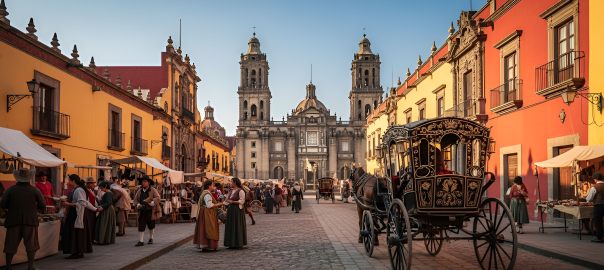
At the heart of New Spain stood Ciudad de México (Mexico City), the capital and the largest city in the Americas at the time. Built atop the ruins of the Aztec capital, Tenochtitlán, it was the administrative, religious, and cultural core of the colony. The city featured European-style architecture, bustling markets, government buildings, and churches (especially the grand Metropolitan Cathedral overlooking the central plaza, or zócalo).
Beyond Mexico City, several other urban centers flourished:
- Puebla, founded in the 16th century, was a center of commerce, agriculture, and artisan craft, particularly known for its talavera pottery and textiles.
- Guadalajara served as the regional capital of the west and a hub for agriculture and ranching.
- Zacatecas and Guanajuato became prosperous mining cities, extracting silver that fueled both the local and global economy.
- Querétaro and San Luis Potosí played strategic roles in trade and administration.
Each of these cities had a central plaza, a church, and government buildings, reflecting the Spanish colonial model of urban design and control.
Universities and Education
Higher education in 18th-century Mexico was dominated by religious institutions. The most prominent was the Royal and Pontifical University of Mexico (Real y Pontificia Universidad de México), founded in 1551. (For comparison, Harvard University was not founded until 1638.). It was one of the first universities in the Americas and remained a key intellectual center during the 1700s, offering degrees in theology, law, medicine, and the arts.
Jesuit colleges and seminaries also played a major role in education, particularly for the criollo elite. However, when the king of Spain ordered the expulsion of the Jesuits in 1767, it disrupted much of the educational infrastructure. This event marked a turning point, as the crown sought greater control over colonial institutions, reducing the influence of the Church and fostering a more secular and centralized system.
The Colonial Economy
Mexico’s economy in the 1700s was heavily reliant on mining, particularly silver mining in Zacatecas, Guanajuato, and other mountainous regions. Silver from New Spain accounted for a significant portion of the Spanish Empire’s wealth and helped finance global trade, including trade with Asia via the Manila Galleons.
In addition to mining, agriculture and ranching were essential to the colonial economy. Large estates called haciendas produced wheat, maize, sugar, and livestock, relying on indigenous and mestizo labor. Trade flourished between cities and rural areas, and new economic policies sought to modernize the colony, increase revenues, and reduce local autonomy.
The Bourbon Reforms (named after Spain’s royal family), implemented throughout the 18th century, aimed to reorganize colonial administration, improve tax collection, and stimulate commerce. They also opened up new ports and allowed more trade between the colonies and Spain, although these changes sometimes increased tensions between colonial elites and the imperial government.
Social Classes and Daily Life
Colonial Mexican society in the 1700s was strictly hierarchical, with a racial caste system (sistema de castas) that defined people’s rights, status, and occupations:
- Peninsulares: Spaniards born in Spain who held the highest political and ecclesiastical offices.
- Criollos (creoles): Spaniards born in New Spain who often held wealth and influence but were excluded from top positions.
- Mestizos: People of mixed European and Indigenous descent who made up a growing part of the urban and rural working class.
- Indios (indigenous people): While often living in separate villages with some degree of autonomy, they were subject to tribute and labor systems.
- Negros (Africans): Enslaved and free people of African descent played crucial roles, especially in coastal and urban labor.
- Mulattos: People of mixed Spanish and African ancestry.
- Zambos: People of mixed Spanish and indigenous ancestry.
These divisions were reinforced through law, dress codes, church records, and everyday social interaction. Yet, social mobility, though limited, was not impossible, particularly through military service (see soldados de cuera), education, or wealth. Some mestizos were able to achieve economic prosperity and social acceptance as rancheros.
Seeds of Change
While 18th-century Mexico was a colony deeply tied to tradition and hierarchy, it was also a place of gradual transformation. The Enlightenment, carried to New Spain by books, clergy, and educated elites, began to challenge old ways of thinking. Criollos, in particular, started to question their secondary status in the empire despite their economic and cultural importance.
By the end of the century, these tensions – fueled by the Bourbon Reforms, economic inequalities, and a growing sense of local identity – would contribute to the revolutionary movements of the early 1800s, and ultimately to Mexico’s independence from Spain in 1821.
Conclusion
Mexico in the 1700s was a land of thriving cities, grand universities, and a robust economy based on silver and agriculture. Its society was intricately layered, shaped by colonial power, racial ideologies, and Catholic tradition. Yet beneath the surface of order and control, new ideas and discontent were beginning to stir, setting the stage for the independence movements that would reshape the nation in the century to come.

